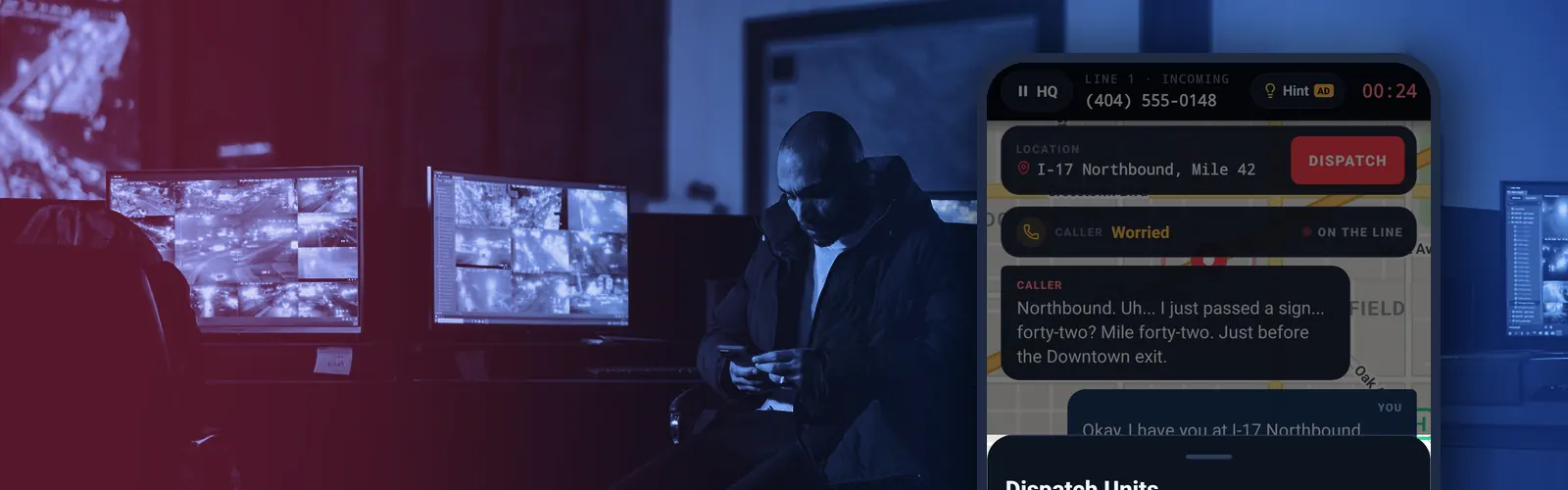
An emergency dispatcher simulator puts you at the console of a 911 center. The phone rings, someone on the other end needs help, and everything you do in the next minute decides how it ends. Here's how that works in 911 Dispatch, from the first ring to the grade at the end.
A call, step by step
- Answer. The line rings. How fast you pick up counts toward your Response score.
- Listen and ask. The caller talks, and you pick what to say from up to three options. Each choice has a timer, so you can't think forever.
- Lock the location. When the caller gives an address, you get three that sound alike: 88 Lakeshore Dr, 81 Lakeshore Dr, 88 Lakeshore Ct. One is right.
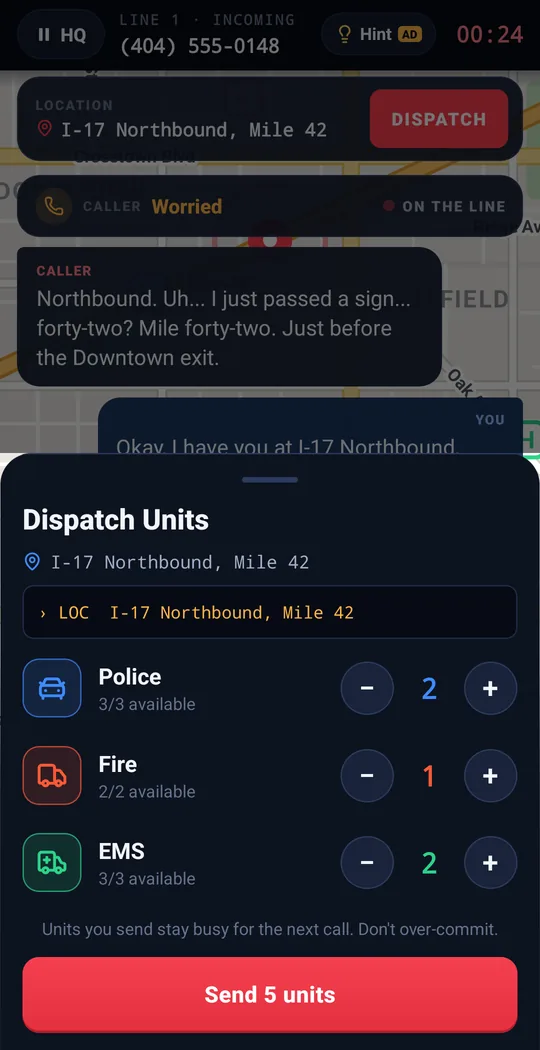
- Dispatch. Open the unit board and choose how many police, fire and EMS units to send. Some shifts add SWAT, harbor patrol, an air unit or hazmat.
- Instruct. While units roll, keep the caller safe: get them out of the smoke, start CPR, stay hidden, keep the line open.
- Debrief. The call ends and you see what happened, why, and your grade.
How each call is scored
Every call is scored out of 100 across four parts:
- Response (25%): how fast you answered and how fast you got units moving, against a target time for that call.
- Dispatch (25%): whether you sent what the call needed. Too few is bad, and so is tying up units that weren't needed.
- Address (15%): whether you confirmed the right location.
- Handling (35%): the quality of what you said. This is the biggest share, because the conversation is where calls are won or lost.
Outcomes cap your score. If the call ends badly, you can't score above 55, however fast you were. A partial outcome caps at 82. Grades run F, D, C, B, A and S, and your XP builds a career rank from Trainee through Call-Taker, Dispatcher I and II, Senior Dispatcher and Shift Supervisor, up to Comms Director.
The unit pool is the real puzzle
Each shift starts with a fixed number of units, shown on the briefing screen. Units you commit stay out for the next call. Send three police cars to a noise complaint and you may have none left when the silent alarm comes in. On the hidden major incidents, units stay committed for the whole incident.
Shift budget pays for HQ upgrades: an extra patrol car, ambulance or engine, more seconds on decision timers, a supervisor who gives a free hint, a caller location trace that rules out one wrong address, and a dispatch advisor that flags which unit types a call needs.
Make it as hard, or as calm, as you like
Relaxed mode turns the decision timer off completely. You can also speed up caller text and change the text size. And if you close the app mid-call, it picks up exactly where you left off.
911 Dispatch is a game. Its calls are fiction, simplified so they can be played, and nothing in it is training for real emergencies. If you need help, call 911 or your local emergency number.